

Most brands fail because their identity doesn’t match their strategy. Your messaging might be strong on social media but weak on your website. Your visual identity might look professional, but your team communicates something completely different.
At Innovative Events, we’ve seen firsthand how misalignment costs companies customers and credibility. This guide shows you exactly how to audit your current brand identity and strategy, spot the gaps, and fix them systematically.
What Makes Brand Identity and Strategy Work Together
Your brand identity and strategy must operate as one system, not two separate pieces. Brand identity is what you present-your values, personality, visual design, and voice. Strategy is how you deploy it to achieve business goals. When they’re disconnected, your audience sees mixed messages. When they’re aligned, every decision reinforces who you are and what you stand for. Most companies build identity first and strategy second, then wonder why their messaging feels scattered across channels.
Define values that actually drive decisions
Core values sound abstract until you test them against real business choices. If you claim sustainability is a value but source materials from unsustainable suppliers, that gap destroys credibility. Your values must be specific enough to guide decisions and honest enough to live up to. Instead of generic statements like growth or innovation, define what those mean operationally. For example, if transparency is a value, that means you publish pricing publicly, share customer feedback openly, or admit when you’ve made a mistake. Marketing and brand strategy work together to drive business success when companies understand their interconnected nature. That trust comes from demonstrated alignment between stated values and actual behavior. Write down three to five values, then test each one with a simple question: Would we turn down a profitable opportunity if it violated this value? If the answer is no, it’s not actually a value-it’s marketing language.
Build personality into how your team communicates
Brand personality is the human quality that makes your company memorable. Old Spice rebuilt its body-wash line with bold, humorous personality in campaigns that felt nothing like traditional deodorant advertising, and sales jumped 107 percent year over year. That didn’t happen because the product improved. It happened because personality made the brand worth talking about. Your personality should emerge from how your team naturally communicates-not a forced character you’ve invented. If your company culture is collaborative and informal, a stiff corporate voice will confuse people. If you attract detail-oriented professionals, a casual tone might undermine credibility. Define your brand voice by documenting how your best communicators already speak to customers, then codify that in guidelines so new team members stay consistent. Include tone examples for different situations: how you respond to complaints, celebrate wins, explain complex features, or address mistakes. This prevents one person sounding friendly while another sounds robotic.
Create visual standards that stick in memory
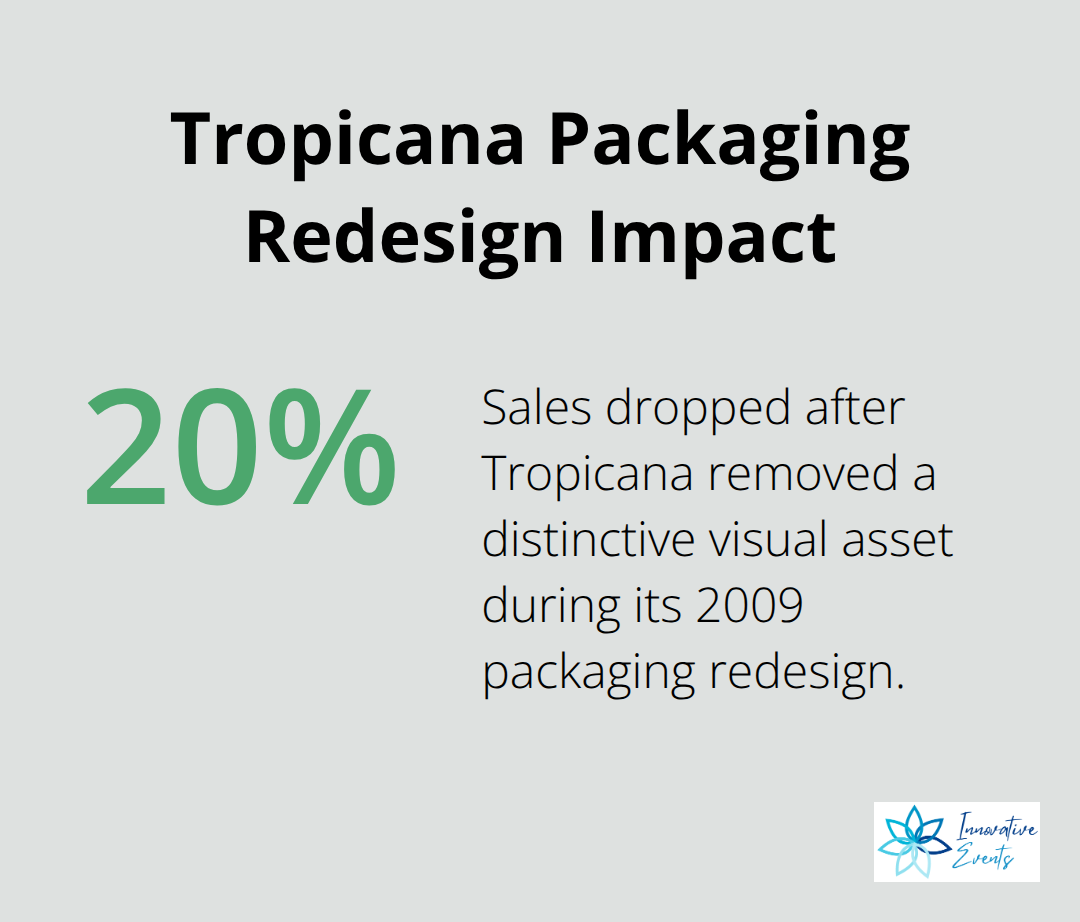
Visual consistency matters more than most brands admit. Tropicana redesigned its iconic packaging in 2009 without customer input and saw sales drop 20 percent. The product hadn’t changed, but removing the distinctive visual asset made the brand harder to recognize on crowded shelves. Your visual identity includes logo, color palette, typography, imagery style, and layout patterns.
These elements should work together to create immediate recognition. Choose colors intentionally: blue conveys trust, green suggests growth, red demands attention. Select typefaces that match your personality-a playful brand needs different typography than a luxury brand. Building a strong brand architecture strategy ensures your visual elements work cohesively across all touchpoints. This guide becomes your team’s reference when creating anything from social posts to presentations. Without it, designers make individual choices that feel disconnected, and your visual identity fragments across channels.
Test alignment before you scale
The gap between identity and strategy reveals itself when you scale. A startup with five people can stay aligned through conversation. A company with fifty people needs systems. Audit your current output across channels-website, social media, email, presentations, customer service responses. Does your messaging sound like the same company? Do your visuals feel cohesive? Do your team members represent your stated values in how they interact with customers? Inconsistencies signal that your identity and strategy have drifted apart. Fix these gaps now, before they compound across more channels and more team members. The cost of misalignment grows exponentially as your organization expands.
Where Your Brand Actually Falls Apart
Most companies never audit their brand alignment until customers point out the inconsistency. Your website promises premium quality, but your email newsletters look like they were designed in 2015. Your social media sounds conversational and friendly, but your customer service responses read like legal documents. These gaps don’t announce themselves-they compound silently until your brand loses credibility.
Start by collecting every piece of customer-facing communication from the past three months: website copy, social posts, email campaigns, presentation decks, customer service transcripts, packaging, and advertising. Print them out or organize them in a shared folder. Now read through them as if you’re a customer encountering your brand for the first time. Does the voice sound consistent? Does the visual style feel cohesive? Do the core messages align with your stated values? Most brands discover that their website and social media contradict each other, their sales team communicates differently than their marketing team, and their visual identity shifts depending on who created the asset. These inconsistencies signal that your identity and strategy have drifted into separate channels instead of working as one system.
Spot messaging conflicts across channels
Website messaging often differs from social media because different people with different goals manage them. Your website might emphasize reliability and expertise, while your Instagram account tries to be relatable and trendy. Neither approach is wrong, but the contradiction confuses customers about what your brand actually stands for.
Create a messaging audit by documenting the primary claim on each channel: What is the main thing you’re saying on your homepage, your LinkedIn profile, your email signature, your product packaging? Write these claims side by side. If they don’t reinforce each other, you have a messaging conflict. For example, if your homepage says you’re an innovation leader but your social media focuses entirely on affordability, customers won’t know which promise to believe.
The solution isn’t to make everything identical. Different channels serve different purposes. But your core message should remain consistent while the supporting details adapt to each platform. Your homepage can emphasize expertise while your social media shows the human side of that expertise. Your email can be more casual than your website, but both should reflect the same fundamental values. Document what your best-performing channels are saying, then use that as your baseline for messaging. Your audience might be responding to a particular tone-that’s valuable data, not a reason to abandon your core voice-it’s a reason to bring more of that tone into other channels where it fits.
Analyze competitor positioning to reveal your gaps
Your competitors are running their own brand audits, and they’re finding white space you’re missing. If three competitors all emphasize speed and efficiency, customers in that category expect speed and efficiency. If you position around quality but don’t address speed, customers might assume you’re slow. This doesn’t mean copying competitors-it means understanding what the market expects and deciding whether to meet, exceed, or deliberately reject those expectations.
Conduct a competitive positioning analysis by listing your five closest competitors and documenting how each one positions itself. What problem do they claim to solve? What audience do they target? What visual style do they use?
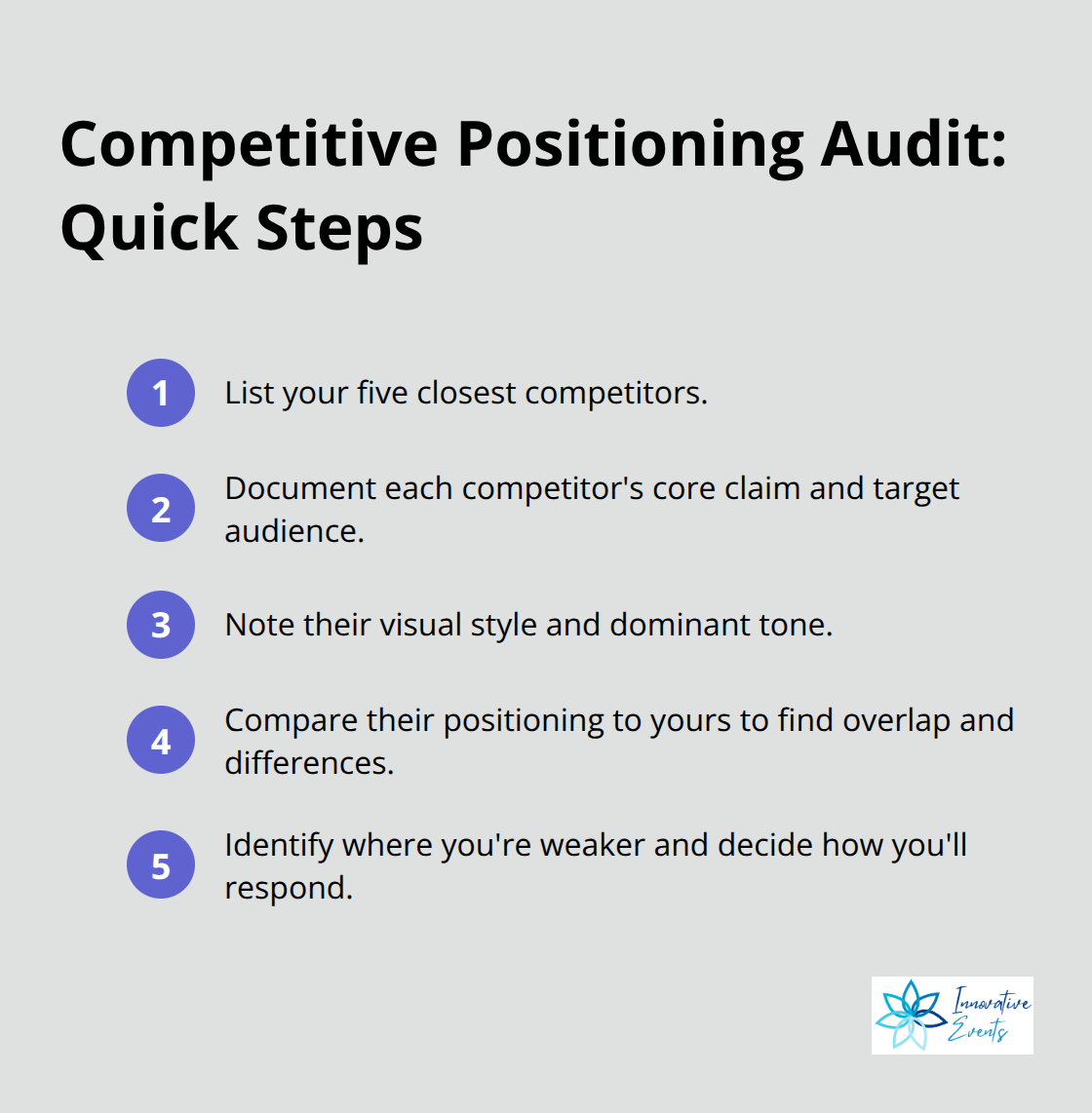
What tone dominates their messaging? Now compare their positioning to yours. Where do you overlap? Where are you different? Most importantly, where are you weaker? If competitors claim faster turnaround and better customer support, and your messaging focuses on price alone, customers might choose a competitor even if your prices are lower. Positioning gaps reveal opportunities to differentiate or warnings that you need to strengthen a claim.
Test your positioning against operational reality
The second part of this analysis is internal: Are you actually delivering on your positioning? If you position as the fastest option but your average response time is slower than competitors, that gap will destroy your credibility the moment customers experience it. Brands make claims they can’t support operationally, and this mismatch surfaces immediately when customers interact with your team.
The fix requires honest assessment of what you can actually deliver, then positioning around those strengths rather than aspirational qualities. If your operations team can’t support a promise, don’t make it. If your product quality genuinely exceeds competitors but your marketing emphasizes price, you’re leaving money on the table. Alignment between what you claim and what you deliver determines whether customers trust you or abandon you for a competitor who walks their talk.
Once you’ve identified these gaps-messaging conflicts, positioning weaknesses, and operational misalignments-you’re ready to build the systems that prevent them from happening again.
Building Systems That Keep Your Brand Aligned
The gap between identity and strategy widens the moment you stop paying attention. You cannot rely on individual discipline or hope that your team will intuitively stay on-brand. You need operational systems that make alignment automatic. Start by creating a single source of truth for every brand decision. This isn’t a 200-page style guide that nobody reads. This is a working document that answers the questions your team actually asks: What color is our call-to-action button? How do we write subject lines for emails? What tone do we use when responding to customer complaints?
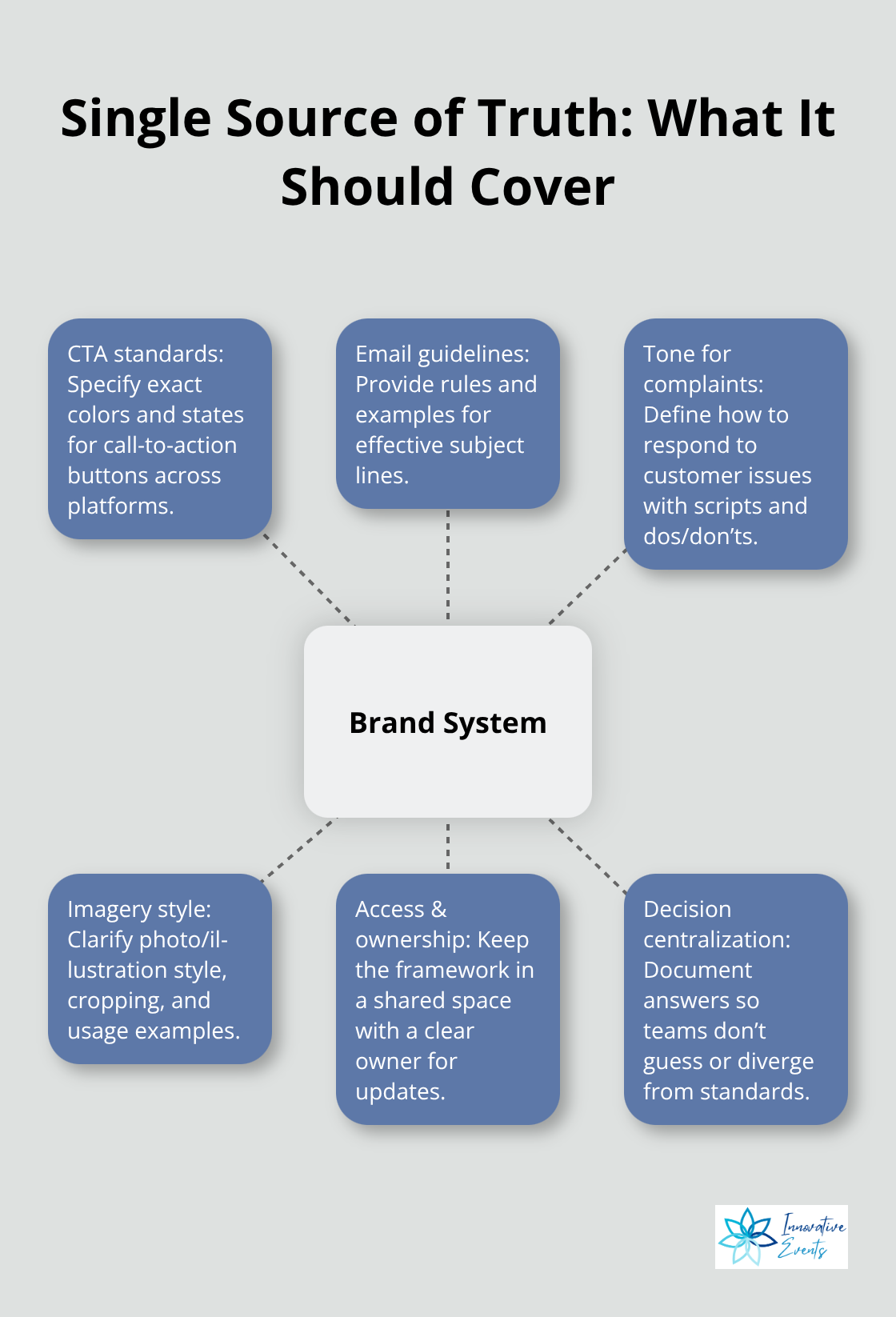
What imagery style do we use on social media? When you centralize these decisions, you eliminate the small inconsistencies that compound into brand fragmentation. Your brand framework should live in a shared space where anyone can access it in seconds, not buried in a folder on someone’s computer.
Make alignment decisions before you create content
Most teams create content first, then check it against brand guidelines afterward. This wastes time and produces mediocre work. Instead, establish decision gates before creation starts. Before your social media team writes copy, they should know exactly what tone to use, what claims you’re making this quarter, and what visual style applies. Before your sales team gives a presentation, they should use your approved templates and messaging hierarchy. Before your customer service team responds to complaints, they should know whether your brand voice is apologetic and solution-focused or confident and explanatory. These pre-creation decisions prevent rework and ensure consistency without slowing your team down. Document your core messaging pillars: three to five core claims that everything else supports. If your pillar is reliability, every piece of content should reinforce that through case studies, response speed, or visual polish. If your pillar is innovation, your content should show experimentation and forward-thinking, not just talk about it.
Audit compliance quarterly, not annually
Annual brand audits move too slowly. The moment you discover misalignment, you’ve already published hundreds of inconsistent pieces across dozens of channels. Quarterly audits catch problems early, when you can fix them easily. Assign one person to spend two hours each quarter collecting recent outputs from every channel-website updates, social posts, email campaigns, presentation decks, customer service interactions. Compare them against your brand framework. Document what’s off-brand and why. Share findings with the teams responsible, then track whether they correct the issues. This creates accountability without bureaucracy. You’ll notice patterns quickly: maybe your email team consistently uses a warmer tone than your website, or your sales presentations use outdated color palettes. Once you see the pattern, you can retrain that team or update the guideline if your brand has actually evolved.
Train new hires on brand standards before they create anything
The moment someone joins your team, they should understand your brand identity and strategy before they touch any customer-facing work. This isn’t optional onboarding. This is fundamental. Create a one-hour brand orientation that covers your core values, your positioning statement, your target audience, your visual identity rules, and your tone guidelines. Show examples of on-brand and off-brand work. Let them ask questions. Then have them create something small-a social post, an email draft, a presentation slide-and review it against your standards. This one-hour investment prevents months of corrections later. Without this, new people reverse-engineer your brand from existing work, and they often reverse-engineer the inconsistencies rather than the standards.
Final Thoughts
Brand identity and strategy alignment compound over time as your team moves faster and customers recognize you instantly. Your marketing spend becomes more efficient because every channel reinforces the same message instead of competing for attention, and this coherence builds the trust that drives loyalty. Start with one audit this quarter, collect your customer-facing outputs from the past three months, and compare them against your stated values and positioning.
Assign one person to own your brand framework and update it quarterly as you learn what actually works. Train your next hire on your brand standards before they create anything. These three actions cost almost nothing but prevent the costly misalignments that fragment your brand across channels.
We at Innovative Events help companies build cohesive brand experiences that reinforce identity and strategy. Explore how strategic event marketing can strengthen your brand alignment.