

B2B brand strategy isn’t a luxury-it’s the foundation that separates market leaders from forgotten competitors. Decision-makers in your industry are evaluating you based on credibility, expertise, and consistency long before they consider a purchase.
At Innovative Events, we’ve seen firsthand how companies that master their B2B brand positioning attract better clients, command premium pricing, and build lasting market influence. This guide walks you through the exact framework to build a brand that resonates with your target audience and drives measurable business growth.
How B2B Branding Differs From What You Already Know
B2B branding operates under fundamentally different rules than B2C marketing, and most companies misunderstand this distinction. In B2C, a single emotional trigger can drive a purchase decision within days. In B2B, your brand must prove its worth across multiple touchpoints over months or years. According to research from the Harvard Business Review, B2B buyers consume an average of 13 pieces of content before engaging with a sales team. This means your brand strategy cannot rely on flashy campaigns or viral moments-it needs substance, consistency, and demonstrable expertise.
The Complexity of B2B Decision-Making
The buying committee in B2B sales includes finance directors, operations managers, and C-suite executives, each with different priorities. Finance cares about ROI and risk mitigation. Operations wants reliability and scalability. Leadership demands innovation and competitive advantage. Your brand must speak credibly to all three simultaneously, which is why generic messaging fails spectacularly in B2B contexts.
What Actually Builds Trust in B2B Markets
Decision-makers evaluate B2B brands based on three non-negotiable factors: proven track record, technical competence, and operational reliability. They are not buying a feeling-they are buying a solution that affects their business performance. This is why case studies, client testimonials, and industry certifications carry far more weight in B2B than polished brand aesthetics.
Companies like Salesforce and HubSpot built billion-dollar valuations not through lifestyle branding but through transparent communication about what their products actually accomplish. Your brand strategy must include concrete evidence of results. If you serve enterprise clients, document your implementation timelines, customer retention rates, and measurable outcomes. If you work with mid-market companies, showcase how your solution integrates with their existing systems and what efficiency gains they achieved. This specificity separates credible B2B brands from pretenders.
Leading With Expertise, Not Sales Pressure
B2B brands commanding premium pricing all share one trait: they lead with expertise first and sales messaging second. They publish original research, host industry roundtables, and position their teams as thought leaders before asking for business. This approach builds authority that translates directly into client confidence and higher contract values.
The brands that win in B2B markets understand that your audience needs proof before trust, and trust before commitment. Your next step involves identifying exactly who makes these decisions in your target market and what evidence they require to move forward.
Building Your Competitive Position in B2B Markets
Map Your Actual Decision-Makers
Identifying who actually makes purchasing decisions in your target market is where most B2B brands fail. Many companies create messaging for the wrong persona entirely, assuming the CTO or procurement manager holds veto power when finance controls the budget. Start by mapping your last ten successful clients and work backward through their buying process. Who initiated the conversation? Who asked the hardest questions? Who signed off on the budget?
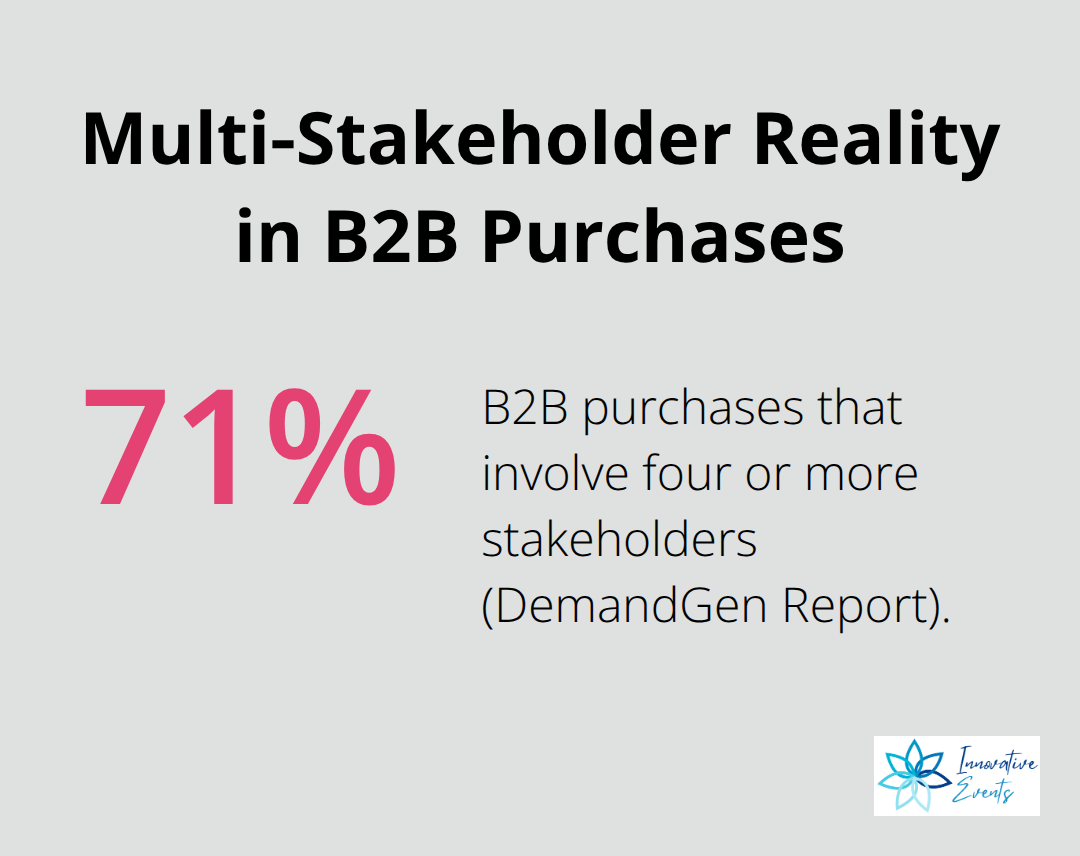
According to research from DemandGen Report, 71% of B2B purchases involve four or more stakeholders, yet most companies market to only one.
Create separate positioning statements for each decision-maker group rather than forcing generic messaging to fit everyone. Finance leaders need ROI calculations with specific payback periods. Operations teams want technical specifications and implementation timelines. C-suite executives care about competitive differentiation and market positioning. Your brand positioning must address all three without compromise.
Test your messaging with real prospects in your target market before rolling it out broadly. Schedule fifteen-minute conversations with three to five companies matching your ideal customer profile and ask them directly what evidence would move them from consideration to commitment. This feedback shapes your actual positioning far better than internal brainstorming sessions ever will.
Define Your Actual Competitive Advantage
Your unique value proposition cannot be what you think makes you different-it must be what your market actually values. Most B2B companies describe their value proposition as faster, cheaper, or more reliable than competitors, which means nothing because every competitor claims the same thing. Instead, identify the specific business outcome you deliver that competitors genuinely cannot match.
If you sell supply chain software, don’t claim better visibility; specify that your clients reduce procurement cycle times or cut supplier management costs. If you provide staffing solutions, quantify how your vetting process delivers strong retention rates compared to industry averages. This specificity becomes your actual competitive moat because it’s verifiable and defensible.
Package this positioning across every channel: your website homepage, sales presentations, email campaigns, and especially at corporate events where you can demonstrate results to multiple stakeholders simultaneously.
Establish Thought Leadership Through Research and Speaking
Thought leadership separates premium brands from commodity players in B2B markets. Publishing original research carries far more weight than general industry commentary because it positions your company as a source of new insights rather than a repeater of conventional wisdom. Conduct a simple survey of one hundred companies in your target market, asking about their biggest operational challenges in your space, then publish the results with analysis.
Speaking at industry conferences matters significantly more than sponsoring them; conference attendees remember speakers, not booth visitors. Target speaking slots at events where your ideal customers attend rather than pursuing every speaking opportunity that becomes available. Quality of venue matters more than quantity of presentations. When you speak at the right events, you position your team directly in front of decision-makers who are actively evaluating solutions in your category.
Your brand positioning now has substance, specificity, and visibility. The next phase involves executing this positioning consistently across all channels where your buyers actually spend their attention.
How to Execute Your Brand Strategy Across Every Touchpoint
Align Your Messaging Across All Channels
Your B2B brand positioning means nothing if your audience encounters conflicting messages across different channels. Most companies maintain separate strategies for their website, email campaigns, sales presentations, and events, which creates confusion rather than reinforcement. The highest-performing B2B brands operate with ruthless consistency-the same core positioning appears in your LinkedIn content, conference presentations, case studies, and email sequences. This repetition builds recognition and trust far faster than varied messaging ever will.
Start by documenting your three core positioning statements: one for each decision-maker group you identified earlier. Then audit every active channel where your target audience encounters your brand. Your website homepage, email templates, sales deck, event booth materials, and social media profiles should all reflect the same core message, even if the format changes.
Integrate Events Into Your Overall Brand Strategy
Most companies treat events as separate from digital strategy, when events actually function as the most powerful reinforcement mechanism you have. At corporate conferences, you stand directly in front of multiple stakeholders from the same company simultaneously-finance, operations, and leadership all in one room. This concentrated exposure accelerates trust-building far beyond what email sequences accomplish.
Companies that treat events as integrated brand experiences rather than lead-generation tactics see significantly higher conversion rates because attendees arrive primed by consistent messaging across channels. The prospect who encounters your positioning through three different touchpoints before meeting your team at a conference has already moved substantially closer to commitment than someone who only receives email outreach.
Track Metrics That Actually Predict Revenue
Measuring brand impact across channels requires abandoning vanity metrics that most companies obsess over. Social media impressions and website traffic tell you nothing about whether your brand positioning actually influences decision-making. Instead, track metrics that directly correlate with business outcomes: average contract value for customers acquired through different channels, sales cycle length, and customer retention rates segmented by which touchpoints they engaged with before purchase.
A financial services company might discover that prospects who attended their industry conference before speaking with sales close faster and sign contracts larger than those who encountered them only through digital channels. That data justifies a significant investment in strategic event participation.
Implement Channel Tracking From Day One
Set up tracking mechanisms before launching any campaign so you capture which touchpoints influenced each deal. Most CRM systems allow you to tag leads by channel, but few companies actually use this data systematically. Review this quarterly to identify which combinations of digital and event touchpoints drive the highest-value customers. Then double down on that mix and eliminate channels that fail to contribute to a qualified pipeline.
This ruthless approach prevents wasting resources on activities that feel productive but generate only low-value leads or no leads at all. Your brand execution improves dramatically once you stop guessing and start measuring what actually moves your target market toward commitment.
Final Thoughts
Your B2B brand strategy succeeds or fails based on execution consistency, not strategy brilliance. Companies that dominate their markets treat brand positioning as a business function, not a marketing department responsibility. Finance, operations, and leadership all understand and reinforce the same core message across every interaction with prospects and clients. The most common mistake B2B companies make is building solid positioning, then failing to implement it systematically across all touchpoints.
Start implementing your strategy immediately by documenting your three core positioning statements for each decision-maker group and auditing every active channel where your target audience encounters your brand. Ensure consistent messaging across your website, email campaigns, sales presentations, and events so alignment accelerates trust-building and moves prospects toward commitment significantly faster than fragmented messaging ever will. Track metrics that predict revenue rather than vanity metrics-measure average contract value, sales cycle length, and customer retention rates segmented by which touchpoints influenced each deal.
Events deserve strategic integration into your overall B2B brand strategy approach rather than treatment as separate lead-generation activities. When prospects encounter consistent positioning across multiple channels before meeting your team at a conference, they arrive primed for commitment, and this concentrated exposure to multiple stakeholders simultaneously accelerates decision-making far beyond what email sequences accomplish alone. Innovative Events specializes in crafting immersive brand experiences that reinforce your positioning and build lasting relationships with your target market through comprehensive event management, marketing content, and speaking engagements designed to elevate your brand presence.